Boulogne Aratea
Carolingian splendor: The Aratus constellations
This ancient illuminated manuscript, known as the Aratea of Boulogne, is an extraordinary relic that offers a window into the celestial and literary interests of a bygone era. Created in the late 10th century, it is believed to have been meticulously crafted for and within the esteemed Abbey of Saint-Bertin in St.-Omer, France. Today, it stands as a rare and invaluable example of medieval science and art, preserved through an exceptional book reproduction.
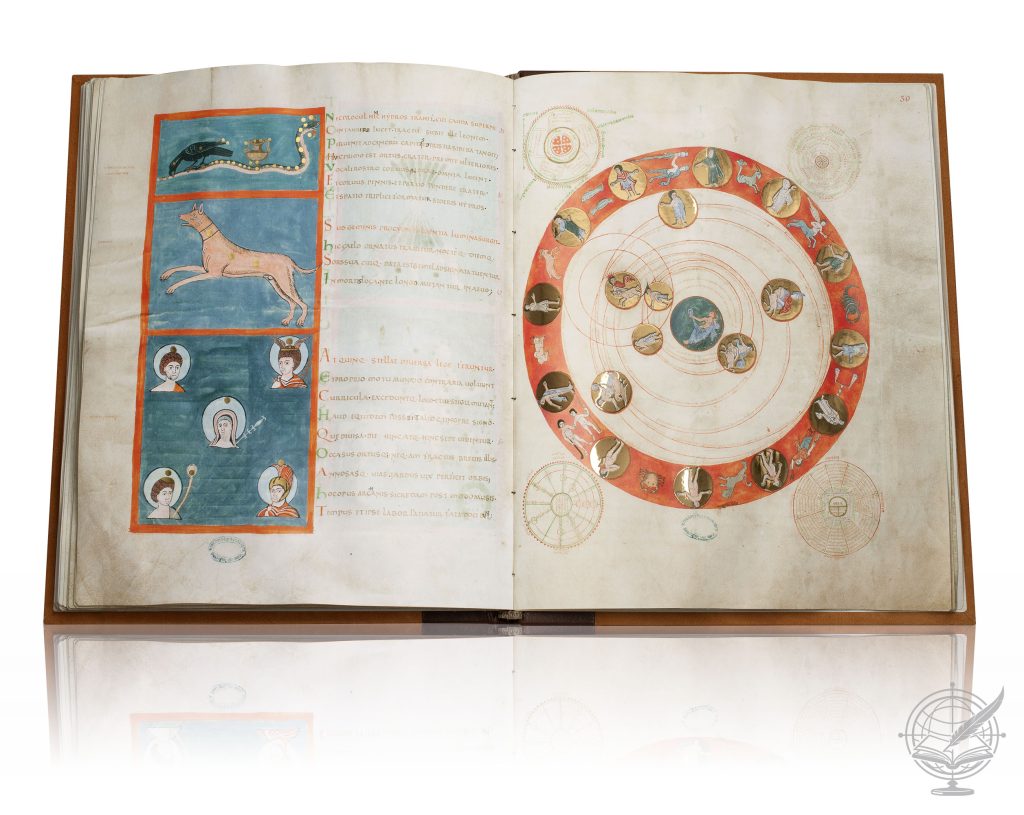
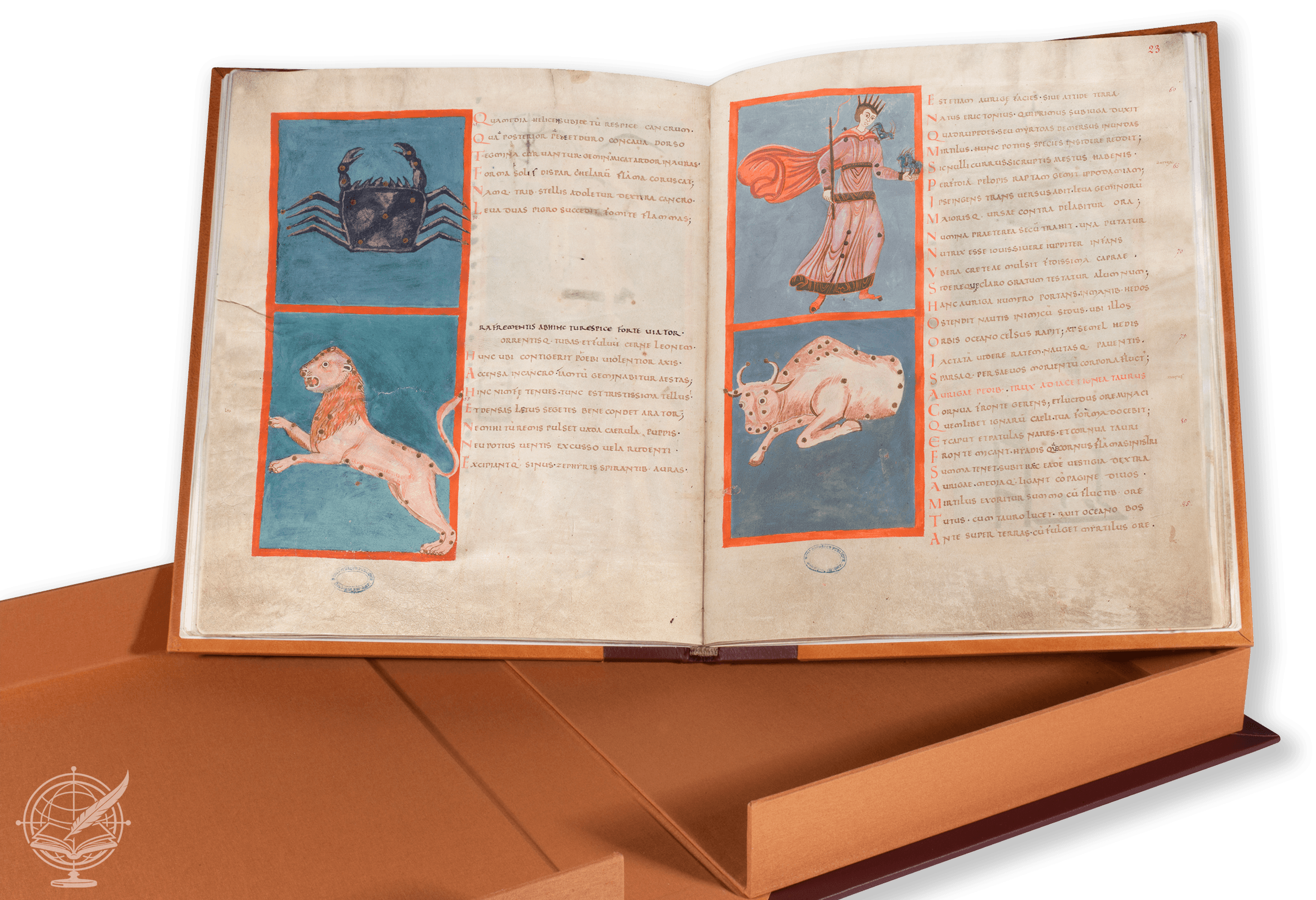
The Aratea of Boulogne is adorned with 41 exquisitely detailed miniatures, each accompanying the Latin poetic narrative. These miniatures vividly illustrate the positions and compositions of the constellations, portraying them as animals, mythological figures, humans, and objects on deep blue backgrounds. Two standout folios—20r and 30r—present a full celestial planisphere and a circular planetary diagram with vibrant representations of stars, planets, and seasons.
The core text is a Latin poetic translation attributed to Germanicus Caesar (d. 19 BCE), based on the Phaenomena by Aratus of Soli, a Greek poet from the 3rd century BCE. This version includes interpolations and expansions by Rufius Festus Avienius from the 4th century CE. Preceding the main astronomical content is a calendar section and computus tables for determining Christian feast dates.
Color in the manuscript is rich and sophisticated, with dominant tones of red-orange, blue, violet, and green, highlighted with silver and gold—an artistic hallmark of a high-status illuminated manuscript. The work opens with a depiction of Jupiter reclining on his eagle (fol. 20v), marked by a silver halo with seven rays, holding a silver orb and golden scepter. He appears semi-nude, dressed in a light purple robe.
The constellations take on dramatic forms, including Greco-Roman heroes like Hercules (fol. 21r) and Perseus (fol. 25r), the winged horse Pegasus (fol. 24r), and the mythical Centaur (fol. 29r). Cetus, the sea monster, appears in a unique hybrid form resembling a canine beast with a fantastical fish tail (fol. 28r). Small golden dots within the illustrations denote the location of stars—somewhat faded over time, but once crucial celestial markers even in the planisphere.
Only three known illuminated manuscripts of this Latin adaptation survive. The Aratea of Boulogne shares textual and artistic traits with the 9th-century Leiden Aratea, though it’s unclear if the Boulogne artists directly referenced it. Both manuscripts use rustic capitals for the main text, typical of Late Antiquity. The calendar tables (fols. 1–10) are written in uncial script, and the explanatory texts (fols. 11–19) use Carolingian minuscule, characteristic of the period.
After the French Revolution, 81 manuscripts from the Abbey of Saint-Bertin were chosen to be preserved in the newly formed Municipal Library of Boulogne-sur-Mer. In 1975, these manuscripts were relocated to a renovated building that once housed the contemplative Order of the Annunciation.
This limited edition book reproduction of the Aratea of Boulogne includes a protective case and a scholarly commentary volume written by experts in medieval astronomy and manuscript illumination. Only 400 facsimiles were produced, each individually numbered and notarized, making it a valuable piece for collectors and researchers of medieval illuminated manuscripts and historical book reproductions.
Today, owning this book reproduction offers an extraordinary opportunity to explore a faithful facsimile of a medieval masterpiece—an enduring testament to the scientific, artistic, and spiritual imagination of the Middle Ages.
Tech Sheet
DATE:
X century.
ORIGINAL KEPT:
Municipal Library of Annonciades in Boulogne-sur-Mer, Ms. 188.
LANGUAGE:
Latin.
FORMAT:
360 x 300 mm.
PAGES:
66 pages.
ILUMINATION:
42 miniatures, 2 of them full page.
BINDING:
Quarter binding leather with gold stamping on the spine.
Interested? Contact us
If you want to know more on this beautiful facsimile, how to admire or acquire it, we will be delighted to attend you.