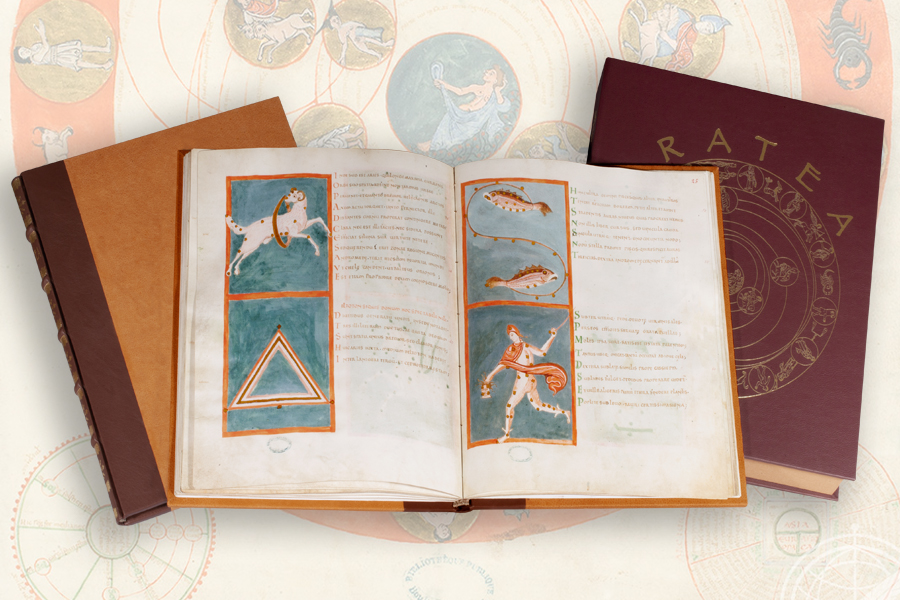
Exploring the Phainomena of Aratus—also known as the Aratea—means stepping into one of antiquity’s most influential astronomical works. But experiencing it through an award-winning facsimile honored as the “Best Edited Book” offers something even more powerful: the feeling that a medieval manuscript, silent for a thousand years, comes alive again through meticulous editorial work, scientific rigor, and artistic fidelity.
What Is the Aratea or Phainomena of Aratus of Soli?
The Aratea is a Latin adaptation of the Greek astronomical poem Phainomena, originally written by Aratus of Soli. A key text throughout the Middle Ages, it served as a bridge between mythology, astronomical observation, and literary tradition. Medieval illuminators transformed it into richly decorated manuscripts where stars, constellations, and mythic figures became visual guides to the night sky.
Historical Background of the Original Manuscript
The facsimile created by Incipit Manuscript is based on the Boulogne-sur-Mer manuscript (10th century) kept in the Bibliothèque municipale des Annonciades—one of the finest and most complete surviving witnesses of the medieval Aratea tradition. Its astronomical miniatures balance scientific intention with aesthetic sophistication. Seeing it reproduced so faithfully offers a rare opportunity to understand how medieval scholars visualized the cosmos.
Its Importance in Ancient Astronomy
Aratus did more than describe stars; he conveyed a worldview—an ordered, meaningful sky. The Phainomena shaped astronomical education for centuries. The illuminated Aratea manuscripts added diagrams, constellations, and symbolic colors that helped readers interpret the heavens long before the invention of telescopes.

The Best Facsimile Edition by Incipit Manuscript
The edition produced by Incipit Manuscript stands out for its technical precision, curatorial integrity, and commitment to faithfully recreating the original manuscript’s material qualities. It is not merely a reproduction; it is a revival.
Origin of the Boulogne-sur-Mer Manuscript
The 10th-century Boulogne-sur-Mer codex is celebrated for its clarity of Latin script, its refined astronomical imagery, and its harmonious palette. Incipit Manuscript’ edition captures these features with impressive accuracy, allowing modern readers to engage with the manuscript as medieval scholars once did.
Reproduction technique: Miniatures, paper, binding
From the beginning, the editorial team sought to recreate the passage of time in the paper, achieving a texture that subtly evokes the aging of the original manuscript. The printing process focuses on fidelity to pigment, luminosity, and fine detail; the award jury specifically praised the remarkable realism of the astronomical miniatures and the depth of color.
The binding was crafted with a balance of historical authenticity and modern usability. The goal was to create a facsimile that one could open, study, and truly use, rather than simply admire from afar.
A separate scholarly volume developed by PhD Kristen Lippincott accompanies the facsimile, offering historical, cultural, and scientific context—an invaluable resource for academics, collectors, and enthusiasts of written heritage.

The Award for Best Facsimile
What Is the “Best Edited Book” Award?
Granted annually by the Ministry of Culture, this prestigious award recognizes excellence in book design, production quality, editorial innovation, and contribution to cultural heritage. Winning in the facsimile category requires exceptional craftsmanship and scholarly integrity, being honored and exhibited in the LIBER, Leipzig and Frankfurter Buchmesse Book Fairs.
Why the Jury Selected This Edition
The jury highlighted:
- Outstanding realism of the illustrations and color treatment
- High-quality paper that evokes the material presence of the medieval original
- Expert binding that ensures durability and ease of use
The award confirms the edition’s success not only as a reproduction but as an editorial achievement that bridges medieval craftsmanship and contemporary technology.

Who This Edition Is For
Collectors of Illuminated Manuscripts
The Phainomena facsimile is an essential piece for collectors seeking masterpieces that combine scientific history with artistic illumination. Its authenticity and award recognition make it a standout item.
Scholars of Astronomy and Classical Culture
The accompanying study volume adds considerable academic value. It contextualizes the Phainomena within ancient science, medieval transmission, and manuscript tradition—making this edition ideal for researchers.
Enthusiasts of Heritage and Book History
Even readers without specialized training find themselves captivated by the vivid constellations, the texture of the pages, and the sense of holding a cultural artifact with a millennium of history behind it.


Where to Acquire It and How to Preserve It
Recommended Acquisition
The edition is available directly through Incipit Manuscript and their official distributors, ensuring authenticity and proper handling during shipping—crucial for a work of this quality.
Conservation Tips for Facsimiles
Although facsimiles are robust compared to their medieval originals, they still benefit from:
- Moderate humidity
- Avoiding direct sunlight
- Stable temperature
- Clean, dry storage
Properly cared for, a fine facsimile becomes a long-lasting cultural investment.
Conclusion: A Manuscript Reborn
The award-winning Phainomena of Aratus facsimile is far more than a reproduction. It is a deeply faithful, beautifully crafted edition that reconnects modern readers with the scientific imagination of the Middle Ages. Its combination of visual fidelity, scholarly context, and national recognition makes it one of the best facsimile manuscripts available today, and a landmark achievement for Incipit Manuscript.